Procedures & techniques
State-of-the-art microsurgical techniques. Dr Benoit Jenny performs spine operations using the most advanced, modern and targeted microsurgical techniques: surgery under the microscope that is as minimally invasive as possible, with neuronavigation for maximum precision.
Cervical spine
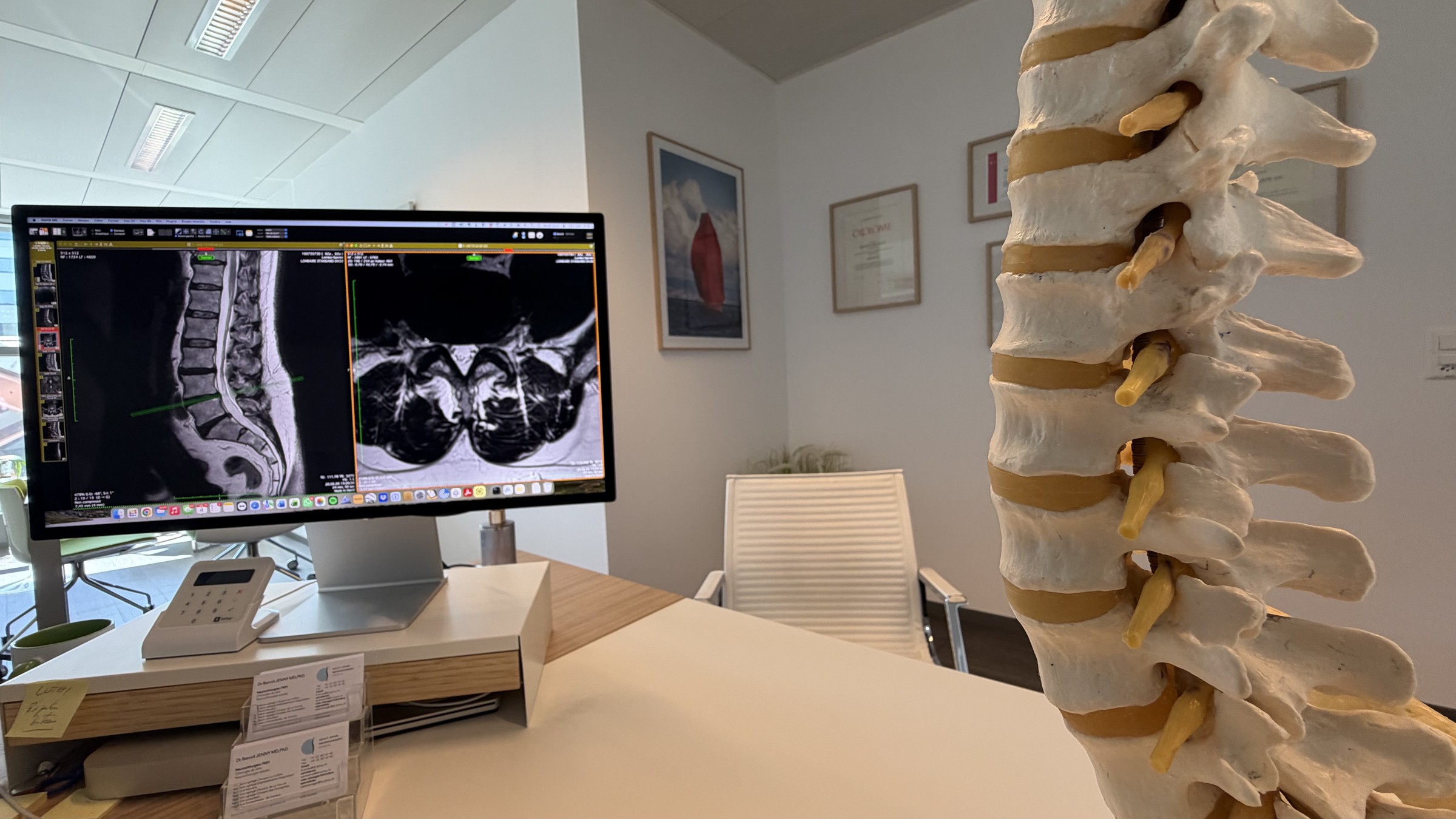
Degenerative disease in the cervical spine can cause compression of the cervical nerves, most frequently the lower cervical nerve roots C5, C6 and C7. In some cases the whole cervical canal can be narrow and causing compression of the cervical cord leading to a "cervical myelopathy". The goal of cervical spine surgery is to free the compression of the nerve roots or the spinal cord.
Procedures on the cervical spine:
- anterior cervical discectomy with placement of a cage
- cervical laminectomy with or without posterior stabilisation
- cervical corpectomy
Lumbar spine
Degenerative diseases in the lumbar spine also cause compression of the nerve roots most frequently L4, L5 or S1. A nerve root compression can be due either to a prolapsed disc or a foraminal stenosis. This causes symptoms known as "sciatica". Sometimes the whole lumbar canal is too narrow and compresses the nerve roots at multiple levels. This condition is known as "lumbar canal stenosis" and causes symptoms known as "neurogenic claudication" and also can cause pain and weakness of the lower limbs while walking. Degenerative process in the lumbar spine can be associated also with a slip from one vertebral body onto the other, a condition known as "spondylolisthesis".
The goal of the lumbar spine surgery is to decompress the nerve roots. Sometimes and especially in case of "spondylolisthesis", the decompression procedure needs to be combined with a stabilisation of one or more lumbar segments with screws and cages in the disc space to induce fusion.
Procedures on the lumbar spine:
- lumbar discectomy
- foraminotomy
- selective lumbar decompression
- laminectomy
- stabilisation one or multiple levels
Stabilisation
In certain situations, when a vertebral segment is unstable due to disc degeneration and the slipping of one vertebra onto the other — which can also cause a narrowing of the spinal canal and compression of the nerves — a stabilisation (fusion or spondylodesis) of the affected segment must be proposed. A spondylodesis is performed by placing pedicle screws and an interbody cage to induce interbody fusion. Single-segment stabilisations are mainly performed at the L4-L5 and L5-S1 levels.
Neuronavigation
Screw placement is performed with the help of a neuronavigation system, allowing extremely precise pedicle targeting and therefore better control of screw positioning.
Neuromonitoring
During complex spine surgery it can be very useful to continuously monitor nerve function during the operation by stimulating the nerves intra-operatively.
Complex spine surgery
Sometimes several segments of the spine are degenerated, or there are very significant vertebral collapses, leading to a loss of spinal stability. More complex surgery must then be proposed, aiming to stabilise several segments and sometimes to replace the necrotic vertebra in order to straighten the spine and free the trapped nerves. The O-Arm® allows intra-operative control of the positioning of the screws and interbody cages.
* all medical information on this page does not replace a specialised medical consultation
To book an appointment, call the practice: +41 22 347 67 40